


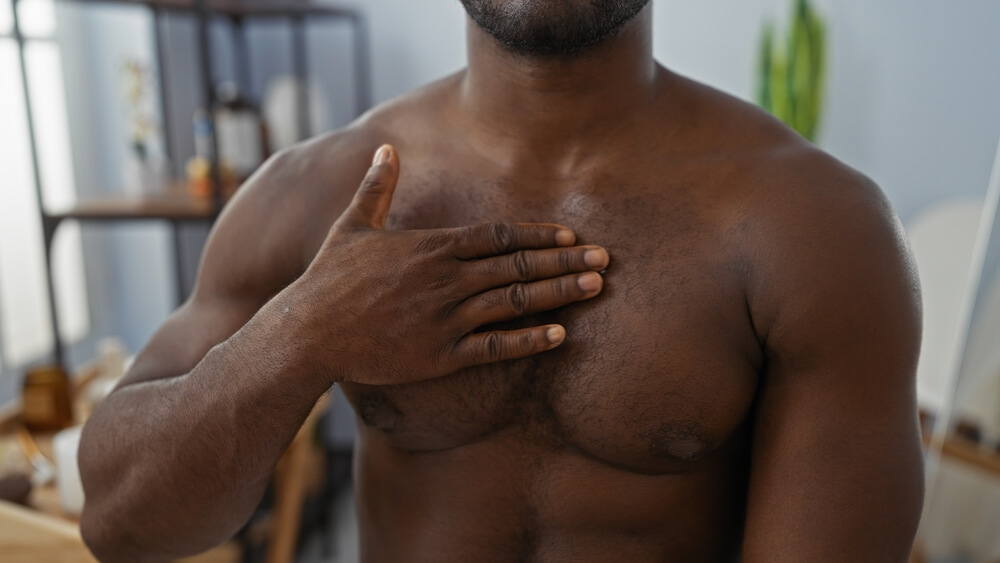
A Less Visible Approach to Male Breast Reduction Using Laser Liposuction Through the Armpit
For many men with gynecomastia, the enlarged breast is only part of the worry. They also fear that treatment will trade one problem for another: a visible scar around the nipple or across the chest. That concern is understandable. A flatter chest can look excellent in a shirt, but a noticeable scar can still make a man self-conscious at the pool, at the beach, in the locker room, or with a partner.
In properly selected patients, I use laser-assisted liposuction through a very small incision hidden in the axilla, the medical term for the armpit. Suction alone may not adequately remove the dense gland beneath the nipple. Laser energy helps break up and soften that glandular tissue so it can be aspirated, or suctioned out, through the same small opening. I describe this as a minimal incision approach because the access point is small and kept away from the front of the breast. It is not incision-free: every surgical incision, including a concealed armpit incision, leaves a scar.
At Cosmetic Surgery Associates in Bethesda, Maryland, I see men who have lived with gynecomastia for years. Some avoid fitted clothing or activities that require taking off a shirt. My goal is to remove the unwanted fullness while keeping a smooth transition and a natural look for the patient’s frame. You can see how we approach male breast reduction in more detail on our procedure page.
Watch: Dr. Richards on Gynecomastia Treatment
What Is Gynecomastia?
Gynecomastia is a benign, or noncancerous, enlargement of glandular breast tissue in men. It can affect one side or both, and the two sides are often unequal. Many men notice a firm, rubbery disc directly beneath the nipple and areola, the pigmented skin surrounding the nipple. When that gland pushes outward, it creates the “puffy nipple” look that many patients find especially frustrating.
Chest fullness caused mainly by fat is called pseudogynecomastia. Many men have a mix of fat and gland, and the difference matters because the two tissues respond differently to treatment. Fat generally responds well to conventional liposuction. Gland is denser and more fibrous.
Why Standard Liposuction May Not Be Enough
Liposuction is excellent for removing fatty tissue and shaping the chest. When the fullness is almost entirely fat, suction alone can deliver a very good result. True gynecomastia is harder. The gland beneath the areola behaves more like a dense disc than soft fat, and a conventional cannula, a slender, hollow tube used to remove tissue with suction, may pass around it. The outer chest can become thinner while the central mound remains, and in some men the puffy nipple becomes more noticeable.
Treatment has traditionally combined liposuction with direct excision of the gland through an incision along the edge of the areola. Excision is effective and remains the right choice for some patients, but it places a scar at the border of the areola and the surrounding chest skin. That scar often fades, yet it sits on the front of the breast, and some men develop scars that are widened, raised, or discolored.
The axillary laser technique is designed to reduce that trade-off. Instead of adding a second incision around the areola, I use laser energy to disrupt the firm gland from within so it can be removed through the small armpit incision along with the fat.
How Laser-Assisted Liposuction Works
Laser-assisted liposuction combines controlled laser energy with suction removal. A slender laser fiber is passed through the small incision into the treatment area, and the energy is directed beneath the skin through the fatty and glandular tissue in a deliberate, controlled pattern.
In the fatty portion of the chest, the laser helps disrupt fat cells and prepares the tissue for removal. In the central breast, it is used to break up the denser gland that standard liposuction may leave behind. A small cannula then aspirates the treated tissue through the same axillary opening.
The laser does not replace surgical judgment. The surgeon must understand male chest anatomy, recognize the boundaries of the gland, control the depth and direction of treatment, and keep evaluating the contour as it develops. Excessive or poorly directed heat can injure the skin or underlying tissues. Technology is a tool; the result still depends on patient selection, experience, and precise technique.
I treat the chest as a whole rather than focusing only on the lump beneath the nipple. The contour must blend across the central, lower, and outer chest near the armpit. Removing too little can leave residual fullness. Removing too much directly beneath the nipple can create a crater, indentation, or an unnatural transition. The best result is not the greatest amount of tissue removed. It is the right amount, removed in the right places.
The Small Incision in the Axilla
The incision is placed in the axilla, or armpit, where it is much less visible than an incision on the front of the breast. The laser fiber and the liposuction cannula both reach the chest through this access point. The exact position and length vary with anatomy and the surgical plan, but the goal is to keep the incision small and place it within a naturally concealed fold or shadow whenever possible.
“Minimal incision” is the more accurate way to describe this approach, and patients deserve an honest explanation. The skin is still opened, and a scar still forms. What changes is where it is. In appropriate candidates, treatment can often be completed with no incision around the nipple, along the areola, or across the visible breast, and the access scars sit in the armpits.
All scars mature over time. An early scar may look pink, red, darker, firmer, or slightly raised. It generally softens and fades over many months, although the outcome varies with genetics, skin type, tension, healing, and aftercare. A man with a history of thick hypertrophic scars or keloids should mention it at consultation. Even a hidden incision deserves careful closure and follow-up.
For many men, keeping a scar off the front of the chest is a major advantage. The armpit is not usually visible when the arms are relaxed at the sides, and keeping the incision away from the nipple-areola complex helps preserve an unoperated look on the front of the breast.


Who Is a Good Candidate?
The ideal candidate has excess fat, a moderate glandular component that can be disrupted and aspirated, reasonably elastic skin, and realistic expectations. He should be healthy enough for an elective procedure and preferably at a stable weight. The technique can be particularly attractive to a man whose main concerns are puffy nipples, localized chest fullness, and avoiding scars around the areola.
Skin elasticity matters. After the underlying volume is reduced, the skin has to contract around the new contour. Younger patients often have excellent skin recoil, but age alone does not decide candidacy. I evaluate skin quality, the degree of stretching, existing folds, nipple position, and the amount of tissue to be removed.
Not every patient can reach his best result through an armpit incision alone. A very large, dense gland may need direct excision. Significant loose skin or a low nipple position may call for skin removal and repositioning of the nipple-areola complex. Those operations leave additional scars, but in a more advanced case, accepting an appropriate scar can produce a much better shape than forcing a minimal incision procedure beyond its limits.
Male breasts are also rarely perfectly symmetrical before surgery and may not be perfectly symmetrical afterward. The chest wall, ribs, pectoral muscles, nipples, and amount of breast tissue can differ from side to side. Surgery can improve these differences, but it cannot always eliminate every natural asymmetry.
Gynecomastia Recovery Timeline
Recovery varies with the amount of tissue treated, your health, the nature of your work, and your individual healing. This is a general guide, and the instructions you receive from our office take priority. For a broader overview, see our male breast reduction page.
The First 48 Hours
Expect the chest to feel tight, sore, swollen, and bruised. Small amounts of blood-tinged fluid may drain from an incision early on. Most patients describe pressure and muscle-like soreness rather than severe pain, and medication helps. Wear the compression garment exactly as directed. Short, frequent walks support circulation, and the rest of the day should be quiet. Do not drive while taking sedating pain medicine or while your movement is limited. Sleeping on your back with your upper body slightly elevated improves comfort.
Days 3 Through 7
Swelling and bruising can look worse before they improve, and the chest may seem uneven, firm, or fuller than expected. These findings usually reflect healing, not the final contour. Temporary numbness, tingling, or altered nipple sensation can occur. Many patients can shower when cleared and manage light daily activity. Treat the armpit incisions gently, and avoid reaching high overhead, forceful pushing or pulling, and lifting. Desk-based workers may feel ready to return within several days to about a week, although some prefer more time.
Weeks 2 Through 4
Bruising fades, soreness eases, and movement becomes more natural. Swelling remains, especially late in the day, and treated tissue may feel firm or lumpy as it heals. That does not mean gland was left behind. The compression garment commonly stays part of the routine, and the new chest shape becomes easier to see as swelling declines. Light walking can increase and, with clearance, cardio may gradually resume. Chest workouts, running, heavy lifting, and contact activity stay restricted until the surgeon clears them. If an activity causes pain or more swelling, stop and call the office.
Weeks 4 Through 6
Most patients are approaching normal daily activity, and the chest generally looks flatter in clothing. With clearance, resistance training and chest exercise can return gradually. Contact sports or anything that could strike or compress the chest may need additional time. Swelling does not disappear on a precise schedule, and one side can heal faster than the other. The nipples may also look temporarily different because of swelling or internal scar tissue. Patience matters in this phase.
Two to Six Months and Beyond
By two to three months most swelling has resolved, tissues are softer, and the contour looks increasingly natural. Sensation often keeps improving, and small areas of firmness may persist while internal scar tissue remodels. Follow-up visits let us tell normal healing from something that may benefit from massage, a garment change, or another recommendation. The final result usually becomes clear at approximately three to six months, and scars keep maturing for a year or longer.
Removed fat cells and gland tissue do not ordinarily return, but the remaining tissue can enlarge with substantial weight gain, hormonal changes, anabolic-steroid use, or certain medications. A stable weight, and addressing any contributing cause, helps protect the result.
Risks and Limitations
Every operation carries risk. Gynecomastia surgery risks include bleeding or hematoma, fluid collection or seroma, infection, delayed healing, contour irregularity, asymmetry, undercorrection, overcorrection, firmness, persistent swelling, pain, changes in nipple or skin sensation, skin injury, pigmentation changes, visible scarring, blood clots, anesthesia complications, and the possible need for revision surgery.
Laser-assisted treatment also carries a risk of thermal injury or burn if heat damages the skin or deeper structures. That is one reason the device must be used with controlled technique and constant attention to tissue response. A small external incision does not make the procedure nonsurgical or risk-free.
No surgeon can promise perfect symmetry, the absence of scarring, or a specific result. Healing varies even when an operation is performed carefully, and a small percentage of patients may have residual gland, loose skin, a contour irregularity, or another issue that requires observation or additional treatment.
Why Choose Dr. Richards in Bethesda, Maryland?
I am a board-certified plastic surgeon and a Fellow of the American College of Surgeons, and I have been in practice since 1989. I have been recognized as a Castle Connolly Top Doctor, named among Washingtonian magazine’s Top Plastic Surgeons, and included in the Consumers’ Research Council of America’s guide to top plastic surgeons. You can read more on my biography page. My broader philosophy, reflected in the minimal incision techniques I use for the face, neck, breast, and body, is to create a natural result while minimizing the signs of an operation.
Cosmetic Surgery Associates is located at 6430 Rockledge Drive, Suite 100, in Bethesda, Maryland, convenient to Washington, DC, Chevy Chase, Potomac, Rockville, Silver Spring, and Northern Virginia. Our in-house operating center is Quad A certified, so you can complete your consultation, procedure, and follow-up visits in one location with a team focused on privacy, safety, and clear communication.
If you are considering gynecomastia surgery in the Washington, DC area, the most useful next step is a personal examination. I can determine how much of the fullness is fat, how much is gland, whether your skin is likely to contract, and whether an axillary laser-assisted approach can give you the result you want without an incision on the front of the breast. You can also browse our gynecomastia before-and-after gallery.
Frequently Asked Questions
How Visible Is the Scar After Minimal Incision Gynecomastia Surgery?
Every incision leaves a scar, so no gynecomastia procedure leaves the skin untouched. With the minimal incision approach, the access incision is small and placed in the armpit, where it is generally much less noticeable than a scar on the front of the chest. It usually fades over many months, and the final appearance varies with genetics, skin type, and healing.
Can Liposuction Remove the Breast Gland?
Standard liposuction reliably removes fat but is less effective against firm, fibrous glandular tissue. Laser energy helps disrupt the gland so it can be aspirated through the small axillary incision. Very large or unusually dense glands may still require direct surgical excision.
Will the Puffy Nipple Improve?
A puffy nipple is often caused by glandular tissue pressing outward beneath the nipple and areola. Reducing that gland can allow the nipple-areola complex to lie flatter. The degree of improvement depends on gland size, skin quality, areolar anatomy, and healing.
Will There Be an Incision Around My Areola?
In appropriate candidates, treatment can often be completed through the armpit incisions alone, and avoiding an incision at the areola is one of the main benefits. Some patients still need a very small incision near the nipple, direct gland excision, areolar reduction, skin removal, or nipple repositioning. If your anatomy calls for one of these, I will explain why a front-of-chest incision may give you a better and safer result.
When Can I Return to Work?
Many patients with desk jobs return within several days to about one week. Jobs involving heavy lifting, repetitive arm movement, or physical labor need a longer restriction. Your timeline depends on the extent of treatment and your progress at follow-up.
When Can I Return to the Gym?
Walking begins early, but strenuous cardio, weightlifting, direct chest training, and contact sports must wait. Activity is advanced in stages, often over several weeks, after the surgeon confirms that healing is on track.
When Will I See the Final Result?
The chest is usually flatter right away, but swelling temporarily hides some definition. The contour improves progressively, and results are commonly judged at approximately three to six months. Scar maturation and subtle tissue changes can continue longer.
What Are the Risks of Laser-Assisted Gynecomastia Treatment?
The risks include those of any surgery, such as bleeding, fluid collection, infection, asymmetry, contour irregularity, and changes in sensation. The laser adds a risk of thermal injury to the skin or deeper tissue, which is why controlled technique and careful patient selection matter. We review all risks in detail at your consultation.
How Do I Find Out Whether I Am a Candidate?
Schedule a consultation with Dr. Franklin D. Richards at Cosmetic Surgery Associates in Bethesda, Maryland. An examination is the only reliable way to determine whether your chest contains mostly fat, removable gland, significant excess skin, or a combination, and whether the minimal incision axillary technique is right for you.
Schedule a Gynecomastia Consultation in Bethesda, MD
If enlarged male breasts or puffy nipples are affecting the way you dress, exercise, or feel about your appearance, there may be a treatment that does not require an incision on the front of your chest. Call Cosmetic Surgery Associates at (301) 493-4334 or request a consultation online. Our office is located at 6430 Rockledge Drive, Suite 100, Bethesda, Maryland 20817, serving patients throughout Bethesda, Washington, DC, Montgomery County, Northern Virginia, and the surrounding region. Questions about cost? See our financing options, or explore our other men’s plastic surgery services.

Board-certified plastic surgeons Dr. Richards, Dr. Jabs, and Dr. Magge lead Cosmetic Surgery Associates in Bethesda, MD. They specialize in personalized cosmetic procedures delivered with exceptional skill and care, helping every patient look and feel their best.
