


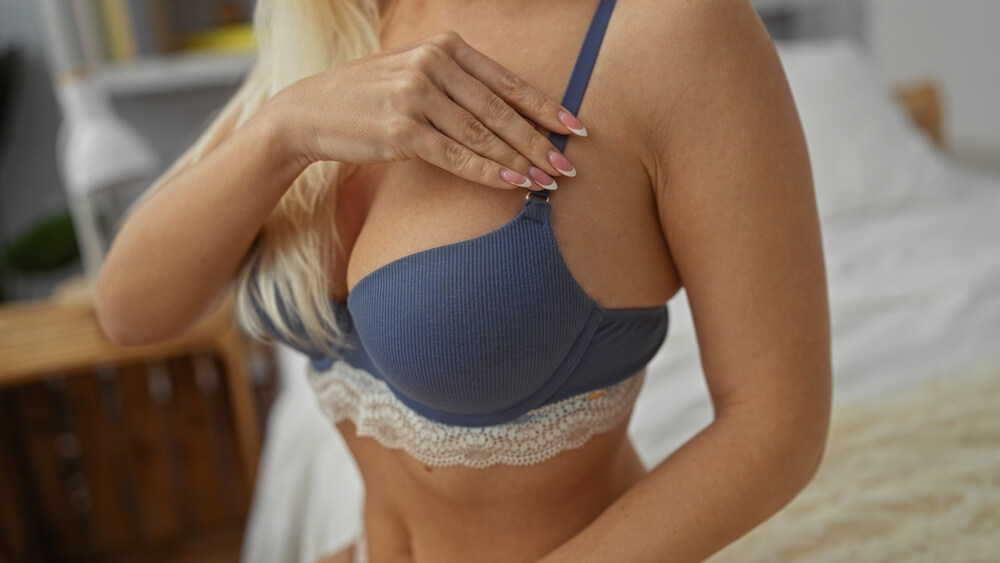
If you’ve been scrolling through breast augmentation results and noticed yourself gravitating toward a certain look, high-set, perky, with a full upper curve and lifted nipple position, you may have heard the term “ballerina boobs.” This patient-driven phrase has become a popular shorthand for a specific breast augmentation aesthetic that is achievable with the right planning, implant selection, and surgical technique. Here’s what it means, whether you’re a good candidate, and what to realistically expect.
What Does “Ballerina Boobs” Mean?
The term “ballerina boobs” describes a high-set, perky breast appearance characterized by:
- Pronounced upper-pole fullness (a rounded, full upper curve)
- A high, lifted nipple position with minimal sagging
- A narrower base width with strong forward projection
- A vertically oriented silhouette with more defined cleavage
The look is often associated with the lean, upright physique of ballet dancers, hence the name. Depending on implant choice and technique, the result can range from subtly natural to more dramatically full. The common thread is that perky, lifted, high-set quality that many patients seek.
Are You a Good Candidate for This Look?
Not every patient is equally suited to achieve the “ballerina” aesthetic, and candidacy depends on a thorough evaluation with a board-certified plastic surgeon. That said, ideal candidates often include:
- Patients with a naturally higher breast position and good skin tone who want enhanced volume and projection
- Those seeking a lifted, perky result without a formal breast lift (mastopexy), provided there is minimal to no breast sagging
- Patients with a narrower chest wall who prefer a vertically projected, high-set silhouette
- Individuals in good general health who are non-smoking (or willing to quit) and have realistic expectations
Patients with moderate to significant breast sagging may still be able to achieve this look, but may require a combined augmentation and breast lift for optimal, lasting results.
What Determines Your Results? Key Surgical Factors
Achieving the “ballerina” look is not a matter of simply choosing the largest implant. Several variables work together to shape the final outcome:
Implant Shape
Round implants tend to provide more upper-pole fullness and are commonly selected for this aesthetic. Anatomical (teardrop) implants offer a more natural slope but less dramatic upper fullness. The right choice depends on your anatomy and goals.
Implant Profile and Projection
High- or ultra-high-profile implants increase forward projection and contribute significantly to the high, perky appearance. Profile selection is individualized based on chest width and desired outcome.
Implant Size Relative to Chest Width
A narrower-base implant placed on a narrow chest wall helps maintain a vertical, projected shape. Oversizing relative to your chest can work against this look and increase the risk of complications.
Placement Plane
Whether the implant is placed submuscular (beneath the pectoralis muscle), subglandular, or in a dual-plane position affects upper-pole fullness, projection, soft-tissue coverage, and the potential for animation. Your surgeon will recommend the best plane based on your anatomy.
Incision Location
Inframammary (under the breast fold), periareolar, and transaxillary incisions each have advantages and trade-offs. Incision selection is based on anatomy, preferred outcome, and surgeon expertise.
Skin Quality and Elasticity
Healthy, tight skin supports a higher and more sustained breast position over time. Skin laxity is an important factor your surgeon will assess during consultation.
Surgical Options and Common Trade-Offs
Round High-Profile Implants with Submuscular or Dual-Plane Pocket
This combination is often used to maximize upper-pole fullness and forward projection. The trade-offs include potential for implant animation (movement with muscle flexion) and a look that some patients may find less natural, though many find it exactly what they want.
Anatomic Implants
These provide a gradual, natural-looking slope and are sometimes combined with a breast lift in patients with sagging. They generally produce less dramatic upper-pole fullness than round implants.
Implant Size
Larger implants increase projection, but choosing a size that exceeds your chest width can undermine the look and increase the risk of complications such as bottoming out, stretching, or a less defined silhouette.
Augmentation with Mastopexy (Breast Lift)
If you have moderate or significant breast sagging, combining augmentation with a lift may be necessary to achieve a high, lasting “ballerina” position. This combination is a well-established approach and is discussed in detail during consultation.
Risks and Setting Realistic Expectations
As with any surgical procedure, breast augmentation carries risks that should be fully understood before moving forward:
Standard Surgical Risks
- Infection, bleeding, or adverse reaction to anesthesia
- Capsular contracture (hardening of scar tissue around the implant)
- Implant malposition, rupture, or deflation
- Temporary or permanent changes in nipple or breast sensation
Cosmetic Considerations
- An unnatural appearance if implants are poorly matched to anatomy
- Visible rippling, especially in patients with thin tissue coverage
- Animation deformity with submuscular placement
Long-Term Outlook
Breast implants are not lifetime devices. Future revision surgery is possible or likely over the course of your lifetime. Not every anatomy can be safely altered to match a specific image; preservation of breast function and health is always the priority.
What to Expect During Recovery
Recovery from breast augmentation is manageable for most patients when they plan ahead:
- Expect 1–2 weeks of limited activity and light rest
- Return to strenuous exercise is typically advised after 4–6 weeks
- Pain, swelling, and temporary tightness are normal in the first days to weeks
- Follow-up appointments are essential for monitoring healing and implant position
- Final results develop gradually as swelling resolves and implants settle into position
How to Choose Your Surgeon
The quality of your result depends heavily on the experience and approach of your surgeon. When evaluating your options:
- Choose a board-certified plastic surgeon with specific breast surgery experience
- Review before-and-after photos of patients with similar anatomy and goals
- Ask about implant types, sizing methodology (including sizers used during planning), pocket plane options, and revision rates
- Discuss long-term maintenance, implant warranties, and the realistic likelihood of future surgeries
- Bring reference photos that reflect your desired look—and be open to professional guidance on what works best for your anatomy
Frequently Asked Questions
What exactly are “ballerina boobs”?
The term refers to a high-set, perky breast appearance with pronounced upper-pole fullness, a lifted nipple position, and a narrow, vertically oriented silhouette. It describes an aesthetic that can often be achieved through breast augmentation with careful implant selection and surgical planning.
Can I achieve the “ballerina” look without a breast lift?
Patients with minimal to no breast sagging and good skin elasticity may be able to achieve this look with implants alone. However, patients with moderate or significant sagging typically need a combined augmentation and mastopexy (breast lift) for optimal results that last.
Which implants are best for the “ballerina boobs” look?
Round, high- or ultra-high-profile implants are commonly selected for this aesthetic because they maximize upper-pole fullness and forward projection. The right implant depends on your individual anatomy, chest width, and goals, which is determined during an in-person consultation with sizing.
Will a larger implant give me a higher, perkier look?
Not necessarily. Choosing an implant that is too large for your chest width can actually work against the high, projected silhouette and increase complication risk. The goal is proportional sizing that complements your frame.
How long do results last?
Breast implants are not lifetime devices, and future revision surgery is possible over time due to factors like aging, weight changes, and normal implant wear. Your surgeon can discuss implant warranties and what long-term maintenance may look like for you.
What questions should I ask at my consultation?
- Based on my anatomy, how achievable and durable is the “ballerina” look?
- Which implant type, size, and placement plane do you recommend and why?
- Will I need a breast lift in addition to implants?
- What are your complication and revision rates?
- Can I see before-and-after photos of patients with similar anatomy?
Schedule a Breast Augmentation Consultation in Bethesda, MD
At Cosmetic Surgery Associates, our board-certified plastic surgeons, Dr. Franklin Richards, Dr. A. Dean Jabs, and Dr. Keshav Magge, bring decades of combined experience to every breast augmentation consultation. We take the time to understand your aesthetic goals, evaluate your anatomy, and recommend the approach that gives you the best chance of a result you’ll love long-term.
If the high, perky “ballerina” look is what you’re after, the next step is a personal consultation with implant sizing and an honest conversation about what’s achievable for your body.

Dr. Keshav Magge, MD, FACS, is a board-certified plastic surgeon serving patients across Bethesda, Washington, D.C., and Northern Virginia. Known for his expertise in deep-plane facelifts, facial rejuvenation, breast augmentation, mommy makeovers, and male breast reduction, Dr. Magge is recognized for delivering elegant, natural-looking results to patients locally, nationwide, and internationally.

Why a Deep Plane Facelift Costs More: What to Know Before Your Consultation – Dr. Magge
October 5, 2026
If you have started researching deep plane facelifts, you have probably noticed that they often cost more than a mini facelift or a traditional…
Read more
Gynecomastia After Weight Loss: Why It Happens and How Surgery Can Help – Dr. Magge
September 1, 2026
Losing a significant amount of weight changes more than the number on the scale. For some men, it also exposes a frustrating leftover: a…
Read more